As part of our course units for year 2, we were given the theme title 'fields and frames.' This was given to us as well as the unit 'dance film.' To extend our knowledge of experimental media and dabble in new forms and pave a direction that could potentially make us our own pioneers in film technology and new digital media.
Here I started to look at a few short films dated back before the 21st century as inspiration and to grapple onto the idea of what experimental film was back in the past and what it could be today.
Although there are a vast array of short films I've discovered perusing the internet, I've only selected a few to show. As the rest, They can be found in the link below that should direct you to Youtube.
By Buster Keaton & Edward F. Cline. The year 1922.
Although a more satire approach to short film it certainly was a forefront for new media in the early 1900s. This is a three part series and the one I've selected is the last of the three. What I like so much about this is its physical and humouristic approach. The early forms of stunt performance and visual effects could also be appreciated in Keaton's work.
LE VOYAGE DAND LA LUNE
By Georges Méliès 1902
Widely known by many and one of my favourites researched so far. Its strong use of effects offers the short film a visual richness in terms of media technology, enhancing the viewer's film experience on fictional based stories.
ALICE IN WONDERLAND
By Lewis Carroll -1903
A classic tale told, in short, is something to marvel.
Okay, so today we were brought back into the visual effects suites in uni and were reintroduced to Adobe After Effects. It has been a while since I last did a project on After Effects. However, we (the group) managed to get back into the swing of things as we began warming up and refreshing our memories on tools, skills and shortcuts.
The main point of this workshop was to introduce us to the next unit for our term 2 professional toolkit. The brief is as follows;
It is your task to plan and deliver a title sequence for a major film or television series. A title sequence is a delicate balance between text and audiovisual aesthetics. One could argue that the function of a title sequence, as being a sequence of titles, is paramount. However, a title sequence is often a component of the narrative body and form of the film and must flow between scenes or adequately play on the excitement/trepidation of an audience – a gateway into the temporal space generated within that particular narrative construct. The work must fulfil particular aims:
1. The sequence must display a relevance to the program you choose.
2. The sequence must demonstrate an ambitious departure from the original title sequence.
3. You must construct all of the assets.
So, now we were debriefed we began with our first lesson into AE by creating and using text.
This was to show us how to animate text and manipulate and use appropriate font families, in order to create our piece. The final result of that day will be uploaded soon as currently, I am adding music to give it a finishing touch.
Continuing on with my project I am researching further into studio and stage performances for art and contemporary dancing, but also exploring the use of camera angles and space with fewer lighting.
The project was to create a soundpiece 30 to 60 sec long and to create two versions, one with narration and the other without based off a piece of text.
The text could be from anywhere. Advertisements, books, poems etc...
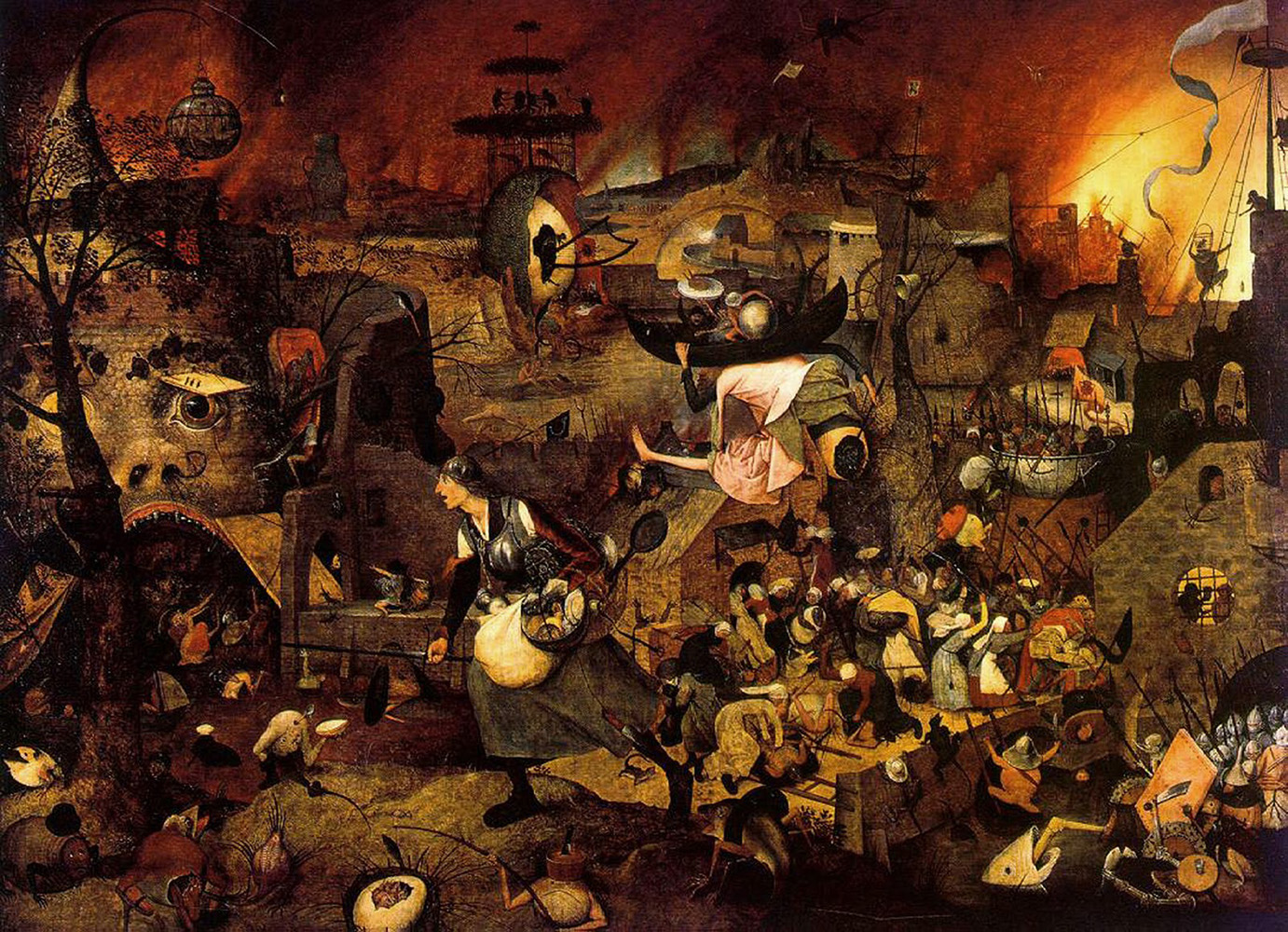
My first idea was to create an aquatic underwater scene based off the Greek mythology of Atlantis. As grand o fan idea it sounded I had to put that aside as it was far too much of a challenge to perfect in such a small amount of time and so had to be a little more realistic. The next idea was creating a warm busking fire burning in a large fireplace and the sounds of family cheer and merriment as a lead up to Christmas. As perfect as xmas as this sounded again i had to dismiss this idea as the deadline was way before this. So going back to what I know, I began to revisit some of the previous work I did, in particular my first soundpiece about a painting called 'Dulle Griet'.' This painting in short, is the depiction of a thunderous horde of angry women plundering hell and sacking it of all its treasures.
Dulle Griet by Pieter Bruegel the Elder, 1562.
My intentions, now was to continue this painting in a sort of part two, to my first piece.
This subsequently lead me to the idea of creating a marching army that was hell regrouping just outside the plundered town in the underworld and getting ready to march forth into battle again.
The text used was an extract from a longer piece of text created by me in order to immerse myself in the moment.
Narration Their march shook the ground, Thousands upon thousands did they go, like a swarm of a locusts. Their cries soared high up into the sky thundering a monstrous roar. Clouds and lightening coveted the sky in shadow as the rain fell down, calming the fires that engulfed the lands below. As, the legions proceeded to the front of this war. This fight was only at its dawn. But who would win? No one could tell.
-------------------------------------------
Research
Overtime I came across various clips from movies that had marching armies and then came across one that was from the Lord of the Rings trilogy, It seemed almost perfect that a fellow sound mixer had overdubbed a scene in which thousands of creatures begin marching out of a castle and onwards to the enemy settlement.
It gave me the idea to use pots and pans and cutlery for the clanging of weapons and further reasearch into other videos gave me more ideas and techniques i could do in pro tools
I now had an idea and inspiration to begin myself off with and so began booking the Foley room out as much as i could to give myself suffcient time to collect all the necessary sounds required to create my piece and finish in Pro tools.
All sounds were made and created by me.
Some of the sounds made were created with the following;
Lightening : paper and tissue ripping and being torn up.
Rain : Rice falling down onto paper
Marching boots on the ground : Soccer boots in a box of rocks and dirt
Clanging of metal armour : my house keys on a metal reading stand used for music
Chanting and roaring: all done by me
Post production
The voices themselves took a bit of time and work and will say it that it was the hardest sounds to get right. Trying to make them sound like a thousand was harder but eventually with enough time in tutorials such as Lynda.com and techhow sites as well as vimeo and youtube i resolved the issue by overdubbing the sounds and then using a reverb and adding an echo to give it that church hall effect.
A lot of the others were enhanced in protools effects and some I had to change the base or or pitch in order for them to sound like the real thing.
I also used garage band in order to help me get the sound of the horns at the beginning and at the end the celestial voices fading off and ending the piece. All sounds were created by me over the digital piano and I also had a casio piano keypad in which I used to create my music for the piece.
The beginning of the piece I began first positioning the sounds in order to make them sound accordingly how I imagined it to be.
This is the what the end piece looked like in pro tools looked like before bouncing the audio onto my hardrive. Unfortunately I wasnt able to return to it to give it a polish off but alas....twas not meant to be.
The entire piece was worked at and completed in approx two days, however due to technical issues during post editing I couldn't complete and finish a clean cut version of my piece. The error was, the software, consistently! kept rejecting my saved projects or would not load up the media required to do the editing on and so personally I was distressed at not being able to polish off my final piece but in all I was proud of the soundscape.
It was a two-bit part workshop that spanned over two weeks every Wednesday, all day. This workshop was primarily focused on our ability to conduct actors professionally on set and to enhance our terminology in order to provide a clearer understanding of the actor's when explaining a directors vision. It also gave us the opportunity to discuss issues and questions raised during the workshop with two professionally brought in actors that have experience in this area.
During the actor's workshop, I learnt a few interesting pointers when guiding actors on set and becoming efficient when casting them too. below there are bulleted pointers made during the workshop that I took down, in hopes they'll guide me through my projects.
- Actors cannot expect one director to be a straight minded director with one idea only or a curved director who is too flexible with the changes, with no clear vision. It's more prudent to adapt to counter the levels of risks that might arise.
- Be suggestive to how you phrase a scene to an actor. Verbs and terminology are key!
- When necessary be ready to use the magic 'As if.'
- Make words definitive and ensure emotion is conveyed exactly how its intended. Stay cautious not to overdo it with the interpretation of the scene. Sometimes the little the better can give the scene the impact you need.
- Create status to bring in the attention
- When hiring actors you must take seriously when deciding what role they'll be playing. The higher the skill level the greater the chance of doing a better job. You can't have a comic based actor playing a serious drama role if it isn't what you're going for.
Using Ralph Meatyards image title ‘Untitled, 1962’ we intend to create an abstract moving image piece, involving two actors to portray the joining and harmonising of Yin and Yang entities embody by two performers. The performers will blend a mixture of dance and theatrical movement to traverse the studio set that blends hectic nature of the two spiritual forces along with their tranquillity.
‘Untitled, 1962, Ralph Meatyard’
Treatment
In the shoot, we want to craft the convergence of Yin and Yang coming together after being in separation for an undetermined amount of time. The shoot will explore four stages of this convergence: first the emptiness of the setting, the setting will hold this ethereal nature to it with the movement of the curtains establishing a flow of the film; second is the first stage that introduces both Yin (Played by Nina Sayuri) and Yang (Played by Alice Ball), their stances are split into ‘Fast (Yin) and Slow (Yang)’ and their choreography and movement will reflect these stances/ tones/ characteristics of Yin and Yang respectively. Each of these performances for Slow and Fast will be performed a solo by Yin and then Yang, from different shot choices to then be edited together in post with some pick-ups collected once primary shooting has wrapped in the middle of shoot day two. The next stage is ‘Hide (Yin) and Seek (Yang)’, which is a direct influence from the resource image, and once again the choreography and movement will reflect the positions that Yin and Yang both hold within the scene and within a spiritual context. The next stage is the first stage in which both Yin and Yang perform together and interact with each other; ‘Pull (Yin) and Push (Yang)’ begins the physical bonding of both entities (both performers) as one whole. This leads smoothly into the final stage that is ‘Pull and Push Together’, in which we establish the final moments of the bond finalising in an embrace, as both performers come together as one statue within the space in an embrace.
In terms of the set, the walls will be covered in a fairly thick oatmeal/cream coloured fabric with the desire of it looking like curtains hanging. The reason we have gone for an off-white colour is due to how we light the fabric, if it was pure white it wouldn't show up as well and be very washed out. Therefore an oatmeal colour will be more achievable to get the look and effect we want. In the middle of the set, there will be a thin transparent material in the same colour, they will be attached from the top of the set walls, along to a c-stand hung on a net curtain wire. These curtains will be hung on the wall and the curtain wire in a loose manner that gives us some slack for when we use the fan on set, as we want the curtains to have some movement to them to create a living space. Space itself will hold a surreal and ethereal sense of purpose and place, in that the setting is acting as the capsule in which Yin and Yang are converging. This surreal and ethereal vibe will be achieved through the soft lighting, that will hopefully cast the set and the performers within a glow. While the sound crafted to accompany the dancers shall bridge the surreal with the tranquillity of the space, in that the flowing of the space may be otherworldly (as the source exists outside of the frame) but is mimicking almost the pull and push of a coursing stream/ river.
So this is just a recap of the week and some of the pointers learnt and discussed through lectures and talks. Our lecture began on Tuesday and this was discussing 'Vision, Surveillance, knowledge and power.' Part of our theory which is Cultures of convergence. We conversed with many ideas relating to this subject, such as ideas of Utilitarian, Ocularcentrism, movement and voyeurism. Even studying examples such as Bentham's Panopticon prison as a form of visual control over a large radius. This then progressed to the famous '1984.' George Orwell novel and ideas of Totalitarianism and the formation of ideas of having the 'Big Brother.' (Not the show widely known, but this was also a form of control we discussed as an example to totalitarianism.)
It was then up to us to speculate about the ideas proposed to us and converse with our groups about the many ways this could be interpreted and even our understanding, could be developed through group opinions.
I did find the conversations informative and it did land perspective on ways I as an individual could translate this knowledge into my own work. As we went on we viewed an artist recommended to us by a fellow colleague of ours called 'How not to be seen.' By Hito Steyeri as my tutor put it; being an excellent counterpart to the lecture previously. I did find the concept interesting. This rebellion against a global power was intriguing and at times confusing but it landed perspective on how we as a generation commit ourselves to this virtual world, it is perhaps seen as an Eden. Escapism in some aspects from a world we're not happy in or feel overwhelmed with. Although this short film by Steyeri tells us we can leave it behind. Steyeri is clever to insinuate through to the end you cannot leave completely. That a part of you still exists within the system, a series of data trails to your history so it's almost saying we are trapped. We cannot leave. But, we can hide.
The next week coming up would be dedicated to viewing exhibitions happening in London, gathering research and references to contribute to my studies and inspire me to produce content relatable and also appropriately challenging my theme for both my theory of cultures of convergence and also presenting an opportunity for my short film piece.
Andrew Kotting is known for his peculiar and wildly made short films. Over the years he has created experimental films such as Hoi Polloi (1990) and Smart Alek (1993) for which he has best received the audience's praise for. Kotting has even created a feature-length movie travelling the British coast with his mother and daughter, meeting new people and exploring new places. Though it has been said that he aims to explore more of the darker sides of his childhood memories. Elements of sentimentality and thought-provoking moments can also be said to be involved in his pieces. Revealing an underlining emotional intention.
A consistent theme has seen him collaborating with his daughter Eden, who suffers from an uncurable speech disorder. It is interesting to see that Kotting uses the imagery by his daughter to accommodate his pieces accordingly to the sounds being produced even saying in an interview a lot of what he does aims to facilitate the sounds going on in the background. Now, this is only an observation of his work and perhaps an interpretation of the two but I can see a correlation between his sounds and his daughter. Knowing Eden is unable to convey her meaning or intentions across orally. Is Kotting's work with sound a medium in which gives his daughter a platform to speak through? Using ambient sounds, natural or synthetic and recordings of speeches. Is this the vocabulary he has taught his daughter, shown in his pieces? after all in my opinion its a wonderful touch. I favour this notion because sounds can say a lot much like the saying 'One image can speak a thousand words.' It has a powerful definition of the world around us. As someone who has a family member who suffers from autism. I know the wonders sound could do and say on behalf of an individual.
What I like about his work most of all is his use of sound that in a sense brightens up the background with a translucent form of audio colour. It reminds me of my first soundscape pieces I originally did for my first year in uni, whereupon I based my piece on the painting 'Dulle Griet.' A rendition of hell being plundered by the mightily powerful hordes of women. In the piece itself, I had to consider carefully the interpretation of this image. Right down to the sounds of the elements and the noises echoing in the distance. It really did bring the image to life and can be a powerful addition to a screen project. This is a feature I share in common with Kotting as he himself once said;
"I like to sculpt with the sound in the same way I like to sculpt with the picture and the ideas, The story may change just to accommodate a sound."
When I really think about how the theme Maps & Networks can relate. I tend to think about two ends as it was, separated. By the distance between them. Trying to join, to create a fluent current running to its destination and back again. So when I bring Kotting's work into this I really interpret this as being a bridge between his daughter's impaired speech and the sounds he brings together to form a vocabulary. For her to connect with the world in a way that our networks have, that she's been denied. It shows that even sounds can have a story to tell just as much as a visual one could.
Our summer project's theme was political awareness. We had to develop and research a concept for 3 to 6 related digital images.
In looking for inspiration I began searching for ideas that could help influence my piece and perhaps inspire me to create. I visited a site called 'short films of the week' which is one of my favourite places on the web to go, in order to find some of the most entertaining and informative films done by fellow film makers from around the world. Upon searching I came across this short called 'Alzheimer's: A love story.'
Alzheimer's: A love story,' is a short film that tells the story of the challenging struggle a couple, 40 years together, faced in their lives as elderly people with Alzheimer's. The test of endurance in a relationship is perhaps not at the beginning or middle of a couple's companionship but at the end. In this 17-minute documentary film, you really begin to understand the gravity of the seriousness of such an illness and the damage it can inflict on loved ones and family members.
What I find most moving of all about this story, in particular, is that unbeknownst to me until half way through watching this documentary, is that the couple are same sex partners. This invoked a sense of hardship on me because as we all know same sex rights and marriage have only become accepted and legalised in the last 20 years and that is only speaking about a handful of countries who have welcomed this way of life. This has all developed within my lifetime! When the fight for rights has existed since the early 1900's. So considering the difficulties they likely faced as a young couple simply because of their nature around a time of hateful prejudice, to endure a fight such as theirs. They must now fight Alzheimer's to keep those memories and battles fought. from being forgotten. As one of the partners 'Greg.' had put it:
"Alzheimer's will accept anybody and everybody,
no matter what.
Male, female, young, old, gay, straight.
Alzheimer's doesn't discriminate."
This made the story all the more powerful but equal in cause and at times difficult to watch but it is a problem that now a vast majority of people face in their lives. To those who are unknown to the illness, Alzheimer's is the most common cause of dementia. Which often leads to memory loss and difficulties with thinking and problem solving, something I'd like to call 'death for the living.'
It is a disease that affects the brain and progressively deteriorates the brain tissue causing immobility in some primary functions and in the UK alone over half a million have been diagnosed annually. It is also said that on average the illness affects those of the ages 65 and upwards, but those under it are not exempt from such an illness. Those under are known as 'early- onset Alzheimer's disease.'
Now, if you've been wondering how this is relative to the theme for my summer project or perhaps you already know, here comes my little political rant.
The age range on average for world leaders and government officials, and those with political governmental power has been said to be 40 to 65 and as of last year that range has increased from 45 to 65 from past analysis. I highlight these statistics because I think it's worrying to know that those with the most power in the world are also susceptible to this crippling illness. Theresa May aged 60, Vladimir Putin aged 64, Angela Merkel aged 63, Xi Jinping aged 64 and Donald Trump aged 71, all Heads of State and have maximum authorisation to create and condone laws and repeal acts, exercising the full extent of their power.
Every country has their own laws and rules to filter the power but this is a worrying factor for those whose lives hang in the balance, the aspiring youth and other citizens of the world. It may not be our place to know their well-being but for argument's sake, let's say one of these leaders had Alzheimer's, how could we determine that the right course of action is being made or the decisions agreed in government are the matters most needed attending too and are being handled rationally. How could we know if the minorities are being taken into account in matters of state affairs?
As I said earlier Alzheimer's can cause dementia and create difficulties in problem-solving, so how would we know the choices these powerful people are making, are made in our best interest? Surely we couldn't know as it may well be a kept secret, but regardless of this, the choices made will reciprocate and we'd be liable no matter.
From this, I'm inspired to create a concept from the documentary. Instead of taking memories I want to photograph politically relevant issues at this moment and using the smudge effect symbolically display six Polaroid image in an overall photograph of them and how the possibility of their importance fading away or becoming forgotten.
If you'd like to watch the documentary or browse the collections click the link below!
Gregory Crewdson's suburban settings of an elaborately detailed staged setup of American homes, interiors and neighbourhoods invoke haunting, cinematic photos of alienation and eerie isolation. I've always been interested in Crewdson's work in wanting the reconstruct the world in photographs. His ideas creates a sense of longing with his subjects within the photographs. A deep felt unhappiness that divides them from reality and fantasy adding to what he has created with his dream like world in this controlled environment. His work combines the documentary style of William Eggleston and Walker Evans with a dreamlike quality. Yet unlike those photographers, Crewdson is compelled by how the still image freezes time and sets limitations, once saying he is fascinated with how he can capture a cinematic moment and freeze it for all time. His quietly disturbing American settings, with their immaculately staged lighting and sombre, solitary figures, are often seen as working in conjunction to the works of Edward Hopper.
For my series of images, I wanted to present the emotions of the figure. It is left unintentionally unclear what the subject is experiencing. However this adds to the photographs, giving an underlining mysterious nature to the subjects.
Using Adobe Lightroom and photoshop, I added blue filters subtly into my images whilst retaining most of its colour. The blue gives connotations of a gloomy, lonely and supporting the emotions I intended to present. For many of them I too darkened the frame, reducing the light in the background.
MY RESPONSE 'TERRA FIRMA'
My Series reflects the social deterioration with dealing with mental health and the contemplation of seeking identity as well as the social struggles in a world vastly more interactive and yet ironically where it is increasingly more difficult to find closure. My inspiration comes from the collective works of Carrie Mae Weems, Philip Lorca Dicorcia and Gregory Crewdson, all of which inspired my final series called “Terra Firma.” These photographs were designed cinematically and reflect the works of Dicorcia, stylised like Crewdson’s with the subjects private lives being made exclusive to us like Carrie Mae Weems.
Overall with the outcome I was quite pleased with the results, Although I did not have the same resources as Crewdson did, I feel like it was a worthy achievement for me. The main tool used throughout the project was the manipulation of lighting especially with the last photograph which was particularly one of my favourites. Using the Adobe Light Room I was able to enhance the look of the lighting and tone in all of the images. A few issues I realised was that some of the images had randomised colour marks and that the subjects were looking at the lens in the last image, although I do believe it did not spoil the image itself but merely enhance the reality of it all.
The saying goes in a book of proverbs, published in 1568. One woman makes a clamour, two women a lot of trouble, three an annual market, four a quarrel, five and army, and six the Devil himself has no weapon.
Pieter Bruegel the Elder's work has been inspired by local culture and towns folk beliefs. This painting was created around c. 1568 during the time of the renaissance era. At this time famine and poverty was ripe throughout Europe. Isolation became common amongst townsfolk and such beliefs began to play upon minds of the locals.
Griet which is the name of this piece is a denigrated name given to bad tempered, shrewish woman. It speaks a lot of how Bruegel's depiction of hell was clearly inspired by Boschian like creatures from the painter Hieronymus Bosch. Hence, Bruegel's intentions about this piece became clear. This painting depicts the mockery of ill tempered woman and their outbursts charging through hell, plundering the realm of its possessions and emphasising the fact that bad tempered women can run to hell and back, unscathed and unhindered due to their robust nature. What I found interesting was that the first time I saw this painting I believed to be another depiction of hell and the chaotic damned souls being punished by unnatural creatures. However upon learning more about it I became aware that this is a stampede of women plundering the caverns and sacking hell for all its treasures. This Painting can also relates to the saying "Hell hath no fury like a woman scorned." This piece creates and alternative meaning to the idea of Hell being the worst place on earth and into, a victim of greed and covertness.
For my Experimental sound project I'm going to try and create and eerie tune with various sounds of strong winds and raging fires down to loud screams and roars of onward plunderers moving deeper into hell, perhaps even creating sounds to accommodate the Boschian creatures, which hopefully will intensify the overall feel to this piece. My recording will begin over this week and I will be recording how I achieved my sounds.
The result was unexpected, yet however I am very pleased with the end result. My idea was to create a soundscape that had an western styled heart beating sound yet my end result came out a lot different and more to the style of dark ambient background. With this in mind here is my final version of my experimental sound project.
The purpose of this short film is to touch down on the situation thats been happening over across the atlantic and the recent protests against America's 45th President Donald Trump. Considering Trump is the most talked about issue of late with his new foreign and domestic policies, I wanted to comment visually by merging the protesters against the voice of Trump. Personally I liked the contrast this film created with what we see on the news and how American society depicts him. In my short video those who stand against Trump, silenced by the overwhelming voice which is ironic as Trump being the leader and spokesmen for his country is meant to be singular voice speaking on behalf of his people to the world.
The image below is my own propaganda pieces made to accompany the short contemporary film about the conflict today with Donald Trump. I used the Statue of Liberty because it signifies freedom and felt this was a interesting contrast to play upon. To complete the propaganda piece I added elements of trump to symbolise control over freedom which relates back to his immigration bans and Mexican wall policies.
This week we were tasked to create another short video as part of our weekly assignment. The theme for this was materialism.
Drawing inspiration from one or more of the video artists we have explored, create a short one to two minute work (or work in progress) referencing the materiality of the digital (as opposed to analogue film).
This could be the internet, social media, apps, gaming or digital technology of any kind You might want to explore how images can be manipulated through using premier pro software for example. Think about making something that might play as a loop ie playing over and over again.
MATERIALISM
The inspiration for my short film was the idea that society revolves around currency to survive. But that we survive only to continue earning currency. How we do this in this era is through technological means such as online banking, ATM's, Paypal etc.. this is emphasised by the computerised voice over.