Monday, 25 September 2017

ANDREW KOTTING

ARTIST RESEARCH


Andrew Kotting is known for his peculiar and wildly made short films. Over the years he has created experimental films such as Hoi Polloi (1990) and Smart Alek (1993) for which he has best received the audience's praise for. Kotting has even created a feature-length movie travelling the British coast with his mother and daughter, meeting new people and exploring new places. Though it has been said that he aims to explore more of the darker sides of his childhood memories. Elements of sentimentality and thought-provoking moments can also be said to be involved in his pieces. Revealing an underlining emotional intention.

A consistent theme has seen him collaborating with his daughter Eden, who suffers from an uncurable speech disorder. It is interesting to see that Kotting uses the imagery by his daughter to accommodate his pieces accordingly to the sounds being produced even saying in an interview a lot of what he does aims to facilitate the sounds going on in the background. Now, this is only an observation of his work and perhaps an interpretation of the two but I can see a correlation between his sounds and his daughter. Knowing Eden is unable to convey her meaning or intentions across orally. Is Kotting's work with sound a medium in which gives his daughter a platform to speak through? Using ambient sounds, natural or synthetic and recordings of speeches. Is this the vocabulary he has taught his daughter, shown in his pieces? after all in my opinion its a wonderful touch. I favour this notion because sounds can say a lot much like the saying  'One image can speak a thousand words.' It has a powerful definition of the world around us. As someone who has a family member who suffers from autism. I know the wonders sound could do and say on behalf of an individual.

What I like about his work most of all is his use of sound that in a sense brightens up the background with a translucent form of audio colour. It reminds me of my first soundscape pieces I originally did for my first year in uni, whereupon I based my piece on the painting 'Dulle Griet.' A rendition of hell being plundered by the mightily powerful hordes of women. In the piece itself, I had to consider carefully the interpretation of this image. Right down to the sounds of the elements and the noises echoing in the distance. It really did bring the image to life and can be a powerful addition to a screen project. This is a feature I share in common with Kotting as he himself once said;

"I like to sculpt with the sound in the same way I like to sculpt with the picture and the ideas, The story may change just to accommodate a sound."                                                         
                                                                               
When I really think about how the theme Maps & Networks can relate. I tend to think about two ends as it was, separated. By the distance between them. Trying to join, to create a fluent current running to its destination and back again. So when I bring Kotting's work into this I really interpret this as being a bridge between his daughter's impaired speech and the sounds he brings together to form a vocabulary. For her to connect with the world in a way that our networks have, that she's been denied. It shows that even sounds can have a story to tell just as much as a visual one could.

Monday, 11 September 2017

SUMMER PROJECT


Our summer project's theme was political awareness. We had to develop and research a concept for 3 to 6 related digital images.


In looking for inspiration I began searching for ideas that could help influence my piece and perhaps inspire me to create. I visited a site called 'short films of the week' which is one of my favourite places on the web to go, in order to find some of the most entertaining and informative films done by fellow film makers from around the world. Upon searching I came across this short called 'Alzheimer's: A love story.'

Alzheimer's: A love story,' is a short film that tells the story of the challenging struggle a couple, 40 years together, faced in their lives as elderly people with Alzheimer's. The test of endurance in a relationship is perhaps not at the beginning or middle of a couple's companionship but at the end. In this 17-minute documentary film, you really begin to understand the gravity of the seriousness of such an illness and the damage it can inflict on loved ones and family members.

What I find most moving of all about this story, in particular, is that unbeknownst to me until half way through watching this documentary, is that the couple are same sex partners. This invoked a sense of hardship on me because as we all know same sex rights and marriage have only become accepted and legalised in the last 20 years and that is only speaking about a handful of countries who have welcomed this way of life. This has all developed within my lifetime! When the fight for rights has existed since the early 1900's. So considering the difficulties they likely faced as a young couple simply because of their nature around a time of hateful prejudice, to endure a fight such as theirs. They must now fight Alzheimer's to keep those memories and battles fought. from being forgotten. As one of the partners 'Greg.' had put it: 

"Alzheimer's will accept anybody and everybody,
 no matter what.
 Male, female, young, old, gay, straight.
 Alzheimer's doesn't discriminate." 

This made the story all the more powerful but equal in cause and at times difficult to watch but it is a problem that now a vast majority of people face in their lives.  To those who are unknown to the illness, Alzheimer's is the most common cause of dementia. Which often leads to memory loss and difficulties with thinking and problem solving, something I'd like to call 'death for the living.'

It is a disease that affects the brain and progressively deteriorates the brain tissue causing immobility in some primary functions and in the UK alone over half a million have been diagnosed annually. It is also said that on average the illness affects those of the ages 65 and upwards, but those under it are not exempt from such an illness. Those under are known as 'early- onset Alzheimer's disease.' 

Now, if you've been wondering how this is relative to the theme for my summer project or perhaps you already know, here comes my little political rant. 

The age range on average for world leaders and government officials, and those with political governmental power has been said to be 40 to 65 and as of last year that range has increased from 45 to 65 from past analysis. I highlight these statistics because I think it's worrying to know that those with the most power in the world are also susceptible to this crippling illness. Theresa May aged 60, Vladimir Putin aged 64, Angela Merkel aged 63, Xi Jinping aged 64 and Donald Trump aged 71, all Heads of State and have maximum authorisation to create and condone laws and repeal acts, exercising the full extent of their power.

Every country has their own laws and rules to filter the power but this is a worrying factor for those whose lives hang in the balance, the aspiring youth and other citizens of the world. It may not be our place to know their well-being but for argument's sake, let's say one of these leaders had Alzheimer's, how could we determine that the right course of action is being made or the decisions agreed in government are the matters most needed attending too and are being handled rationally. How could we know if the minorities are being taken into account in matters of state affairs?

As I said earlier Alzheimer's can cause dementia and create difficulties in problem-solving, so how would we know the choices these powerful people are making, are made in our best interest? Surely we couldn't know as it may well be a kept secret, but regardless of this, the choices made will reciprocate and we'd be liable no matter.

From this, I'm  inspired to create a concept from the documentary. Instead of taking memories I want to photograph politically relevant issues at this moment and using the smudge effect symbolically display six Polaroid image in an overall photograph of them and how the possibility of their importance fading away or becoming forgotten. 


If you'd like to watch the documentary or browse the collections click the link below!

BIBLIOGRAPHY 

Short film of the week:


Gabe Schimmel website: 


Alzheimer's: A love story documentary:

Tuesday, 2 May 2017

MULTI SCREEN PROJECT

MULTI-SCREEN PROJECT


BELLE'S THERAPY 


Belle's therapy is a short two-minute film that is my response to the given theme 'Human Body and the Digital world.' The message I wanted to create here was the idea that technology has advanced so much and continues to do so. We will eventually be able to remedy mental and pysical disorders via external methods to greater effect, without the need of pills or medical treatments. Instead we will be able to rehabiliate ourselves with memories created by us. My idea was to create an AI that acts and behaves as a therapist with the treatment being revisiting moments in our lives that made us most happy. The purpose of the multi screen acts out symbolically two timelines of one individual. Visiting the past, whilst also living in the present future. Then in the end being combined together. This reflects the power and dependency our minds will have on technology, greater than we do today.


RESEARCH & EVALUATION MULTI SCREEN PROJECT

RESEARCH MULTI SCREEN


Coming up with ideas for my multi-screen where relatively difficult, despite my pressure for time in completing my other projects I hadn't really given my multi-screen project any thought into what I wanted to portray.  The theme is the human body and the digital world.

SIGMUND FREUD


My first thought of the theme given was the psychological aspect of it. In the past, during my time in college as a psychology student being one of the subjects I took on. We referenced and frequently discussed the works of Sigmund Freud. This I would yet again come across in one of my lectures this year about psychoanalysis. Considering my fascination with the psychological side, this became my base to my multi-screen piece.

I realised that by using multiscreen I could potentially represent a personality disorder within a character. With each screen highlighting a different aspect of the characters personality. This fitted in with the lecture we had, had on Psychoanalysis.


I had also recently become aware, from an Article series I had read, of a concept around MRI scans and other promising innovations that could potentially detect, or even perhaps remedy low levels of serotonin within the human body. Low serotonin is thought to be one of the causes of depression. 


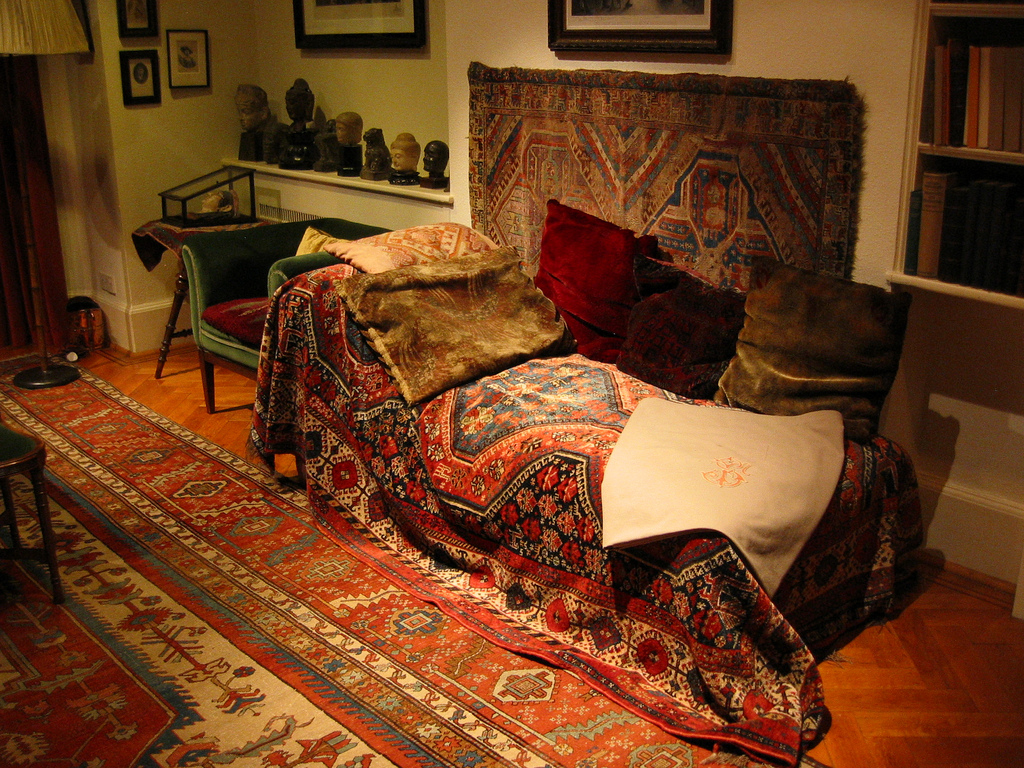
Sigmund Freud's office

In one part of the short film, I wanted to recreate the setup that Sigmund Freud had in his sessions with his patients, this being the Middle Eastern and African patterned fabrics and ornaments. Although this didn't work as I had hoped.


FILMING 


When trying to recreate the Freud style sofa I used a green sheet to act has my green screen, with the intention of adding in an image of a Turkish or African carpet or tapestry. I thought that this would give it that Freud like effect. However I could not find an appropriate image that best suited the aesthetic look of the short piece nor could I make the effect look natural so instead, I used a simple black throw. This highlighted to me that I would need to spend more time learning how to use the green screen effectively, and that more experimentation would be helpful.


Overall the project took me 2 hours to film using canon 700d DSLR wide angle lens. 


The second part of filming I would need to have complete control over the light source, meaning that no natural light could be used in the shoot. This was in order to create the digital glasses effect seen in the finished piece. I decided to do the filming at night, and to use my garage. This turned out to be almost perfect in creating the effect.


EDITING


After I had begun on my filming I then took my work to editing software such as:


 Adobe Premier pro
Adobe Audition


    Media Encoder                                                                                      Adobe After Effects


All the different effects used in my final piece were achieved through collective research from both Lynda.com and Youtube. I found using the editing software to be challenging, and I have identified that much more learning and practice needs to be done in this area. I frequently kept hitting one problem after another and at times had to restart from the very beginning. However, this being said I am very proud of the work I managed to produce in such a short space of time. My particular favourite was the effect I managed to create at the moment of travelling into space and also creating a moving environment for the appropriated images (all royalty free) used to create the space background effect.


ADDING SOUND 


Looking for the right music I had to do a bit of extensive research online and found a few royalty free sounds that I then processed through in audition to deepen the sound or manipulate the sound to give it a more ambient space feel.


The vocal side of the automated AI (Belle) I wanted a soft and human sounding voice however, I found it challenging to find the correct one. In the end, I came across a website that offered a variety of different voices. Eventually, I settled on an interesting one that didn't have a calming, relaxing appeal to the voice but it did however have a subtle and friendly sound to it which made it more joyous and happy.

Overall I am pleased with how it all came together successfully, better than I had originally expected. During the beginning of this project I hadn't given this second unit much thought as my mind became distracted with the group project I was working on at the time. Despite my concerns and doubts, especially when using After Effects, I was pleasantly surprised with my own abilities and the experience has motivated me to do more in After effects. I will say that I wish I'd had more time to produce and improve my film. For example, during editing and reviewing my footage I had noticed some mistakes, some large. If it hadn't been for the lack of time I would've of most likely mended the mistakes and increased the quality of the film, however one thing I have learnt about individual projects involving Adobe After Effects, is to ensure timekeeping is kept efficient and consistent.


BIBLIOGRAPHY 


https://www.youtube.com/watch?v=bG1DXF2C6UE music


Sigmund Freud profile picture:

Sigmund_Freud_LIFE.jpg


Sigmund Freud's sofa image:

http://99percentinvisible.org/app/uploads/2015/06/Freuds-Couch.jpg


Premier pro icon:

https://upload.wikimedia.org/wikipedia/commons/thumb/4/40/Adobe_Premiere_Pro_CC_icon.svg/2000px-Adobe_Premiere_Pro_CC_icon.svg.png


Adobe Audition icon:

http://logos-download.com/wp-content/uploads/2017/01/Audition_logo_Adobe_Audition_CC-1.png


After Effects icon:


Media Encoder icon:


Monday, 24 April 2017

EVALUATION FILM PROJECT

EVALUATION FILM PROJECT

A lot has happened since the last update and a lot about our film has changed. This started when we struggled to find somewhere to film our dystopian footage as all of the studios were booked up. We also came across a problem when we realized, to film outside at night, we would need power for the lights which would be a problem. Eventually, we found a small room that wasn't a studio but was suitable for filming as it contained a white wall, a table, and a chair, which was exactly what we needed. As for the Utopian footage, we decided on using a green screen, in a crew member's house, adding the alleyway in later on.

With our plans set we were able to start filming, however, our first attempt at using a green screen did not work very well as the room we were in was very small which meant that it was difficult to light the green screen properly, leading to an uneven green screen with a hotspot that was pretty much unsalvageable. Another problem was that the subject was closer to the background than we would have liked, meaning that there was green spill on the subject, shadows appeared very easily, and the lights to light the green screen were also lighting up the subject. Eventually, we were able to move the lights so that they did not light the subject, but we also did not have a separate light for us to be able to light the subject separately, with the lighting choice we wanted. This meant that the subject was not lit, and the green screen was unusable, although the footage was unsuccessful, this was an opportunity to learn from our mistakes, realising that we needed more time to set up lighting before we brought our actor in so that we had time to adjust. Something else that we planned, was to test the footage as we shot it, to make sure that the green screen worked before progressing and wasting time on footage that was not going to be suitable.
Our dystopian shoot went well, however, one of our problems was that some of the footage, although stable, was not suitable for the majority of the footage itself was an adjustment. Although, there was a decent amount of usable footage, with the exception of the footage that we had taken of a clock, which was too unstable and therefor not usable, which make a considerable difference to the length of time of the film.

Our second utopian shoot went a lot better than the first, as with a lot more preparation and better equipment, we were able to light both the background, creating a usable green screen, as well as the subject. However, we had come across some timing issues as different members of the crew and cast were not always available. In addition, we could only film at night, as the only room that was available had windows with curtains that did not block out enough light, and with no way to prevent this, we had limited time, having only evenings that our actor was available for to film.

Some of the footage turned out okay, although as for some of the filming I was not available to direct, the footage using things that we could only use once such as paint and the mask (since we only had one and shops were not open in the evenings) could not be reshot, despite not being usable. The party poppers we used also did not show up very well on camera, despite trying to shoot in slow motion as well. Due to unforeseen circumstances such as illness, we did not get around to filming anything to be used in the background, and even if we had of done, there was not enough decent footage to go through with our previous intentions. Overall we were not having much luck as we did not have very much decent footage to work with due to the ideas of what exactly the utopian scene would consist of not being developed early enough, pushing the production back a long time, meaning that we did not end up with the resources that we needed or the time we needed to get it right. To develop and improve, we will develop the production of ideas, so that this kind of thing does not set us back in the future, especially since this is a problem that I find to be reoccurring, stopping me from having the time I need to produce the work that I want to make.

Next came editing, which was difficult to start off with as there was not much usable footage. However, a positive was that the green screen worked and I was able to remove the background very easily, although in the small room we had not been able to pan the camera on such a small green screen, meaning that we planned to do this in editing instead. However, trying to replace the background and also panning with effects looked terrible and with not enough of this footage we decided against this original plan, but also needed a new one. After getting some feedback and advice at tutorials we decided to use the fact that the lighting of our subject wasn't the best, realising that we had the asset of after effects skills to our advantage, we decided upon using silhouettes and appropriated imagery for the utopian screen for the majority, which ended up working very well in our favour, as we were able to use imagery relating to freedom, creativity and such on the inside of the silhouette, using imagery relating to conformity and control on the outside of the silhouette, almost showing what the subject was thinking and what they were surrounded by and subverted to.


In the final edit, on the left screen, we showed the dystopian footage in short chunks, with the sound of a ticking clock used over all of this footage to symbolize repetition and the idea of everything being the same, unchanging, not unique. The first shot was off the subject's eyes, panning from right to left, alternating with the utopian screen. On the utopian screen, we decided to use robotic-like sounds such as white noise and technological sounds, to symbolise both innovation but also a robotic like a way of being, almost suffocating the subject. This screen started off black and white to symbolise how the subject was almost black and white, with the silhouette itself being white on a background, like a blank canvas. We then used barcodes in the silhouette itself, showing how the subject was still almost black and white, although with every barcode being different and unique, almost showing an emerging form of identity. On the outside of the silhouette we then also see binary code, containing only 0s and 1s, trying to show a more robotic and confined idea surrounding the subject. Following this was the silhouette being filled with fingerprints, a more defined sense of identity, yet still black and white. We then return back to the dystopia, showing a finger tapping, showing the seconds going by, all the same, repetition, not unique, with no element of freedom. When the second screen then resumes, the silhouette is filled with images relating to freedom and creativity such as birds to symbolise freedom, crayons to symbolise creativity. Art showing space and in turn almost ultimate possibilities, as well as collaged art showing creativity. All of this imagery flashes in a burst, like thoughts coming and going, like an explosion, a revelation. I also then created effects such as a space like effect, not using any actual images of space, only what I had created in after effects, to show more skills, also animating a rainbow effect. The film ends in all black with the sound of ticking used throughout, almost questioning whether life is all the same and always with be, using that repetition to represent this while showing a completely black screen as though to ask, what is next, or what is your choice, to carry on being the same, just another cog in society, or will you find yourself, your voice, and break free, break out of your silhouette, just another black and white figure, society's mould. We eventually decided to change our working title to the title of silhouette for this reason. In using silhouettes and due to their black and white nature but also in a way being able to represent identity due to every silhouette being unique, it quite nicely summed up what we were trying to show, while also relating to the content very specifically.
FILM PROJECT - TRANSGRESSION

FILM PROJECT -


SILHOUETTE


Here is our final piece for the film project called 'Silhouette.'  This multi screen film features a character who on one screen symbolises repression and manipulation, in an Orwellian artificial bureaucratic setting. On the other screen, we see the character expressing themselves freely in a setting in which anything is possible, exposed to a place of freedom and creativity, symbolised by the use of different appropriated imagery.


Below is an insight to some of the work we did via editing software, such as: Adobe after effects, adobe audition and premier pro.


Sunday, 23 April 2017

FURTHER RESEARCH FOR FILM PROJECT

RESEARCH ON OUR FILM PROJECT


Continuing research on our film project, we began to search for other explorative ideas on Utopian and dystopian idealisms. It became clear that our original idea would not plan out as originally intended, however, we understood our idea had to evolve in order for it to meet our demands. A useful example would be; the lack of space that was available to us that obstructed some of our intended scenes because of equipment not being able to fit, even. Difficulty with availability with crew and cast members, for personal reasons. 
 Our first ideas were of freedom and space. So logically we began searching artwork and photography to appropriate in our film project that was related to space, and what better way to demonstrate freedom and space by being literal and searching works to do with the universe and the galaxy. It took some small amount of time and dedication, we came across Mariano Peccinetti and the wonderful collages he's worked on to create.


MARIANO PECCINETTI


After looking at his work I continued on searching for more artists that had produced similar works to Peccinetti. What makes me choose these pieces is how vibrant they are with colour and expressive in meaning,  revealing subliminal message within or perhaps a euphoric interpretation on the contemplation of the consciousness/subconsciousness.


EUGENIA LOLI 


Eugenia is as well as a vintage collage maker, a filmmaker. And has often encouraged her viewers to create the film's plot based on the surreal otherworldly pictures she's made. A fortunate find that helped contribute to the final project.


BIBLIOGRAPHY 

Mariano Peccenetti website:

http://thereart.ro/mariano-peccinetti-works/


Mariano Peccenetti instagram:

https://www.instagram.com/marianopeccinetti/?hl=en


Eugenia Loli website:

http://eugenialoli.tictail.com