Our second workshop was using the special effects features in After Affects in adobe and the various uses they can have to apply to our work. We did this by collecting various cartoons and glitch videos and joining them together by overlaying them and then using displacement map to distort the figures and blur them. Afterwards I took the the clips to toner and enhanced their colour and over saturated the characters, making them look negative or even gold brown. I'm proud with my video because it teaches me the fundamentals and useful techniques I can use in order to be more expressive with my creativity in digital arts.
This workshop was to teach us the basics of using After affects in adobe to produce moving shapes and overlaying film into another still/moving image. Below are a few examples of the work I'd done during these workshops:
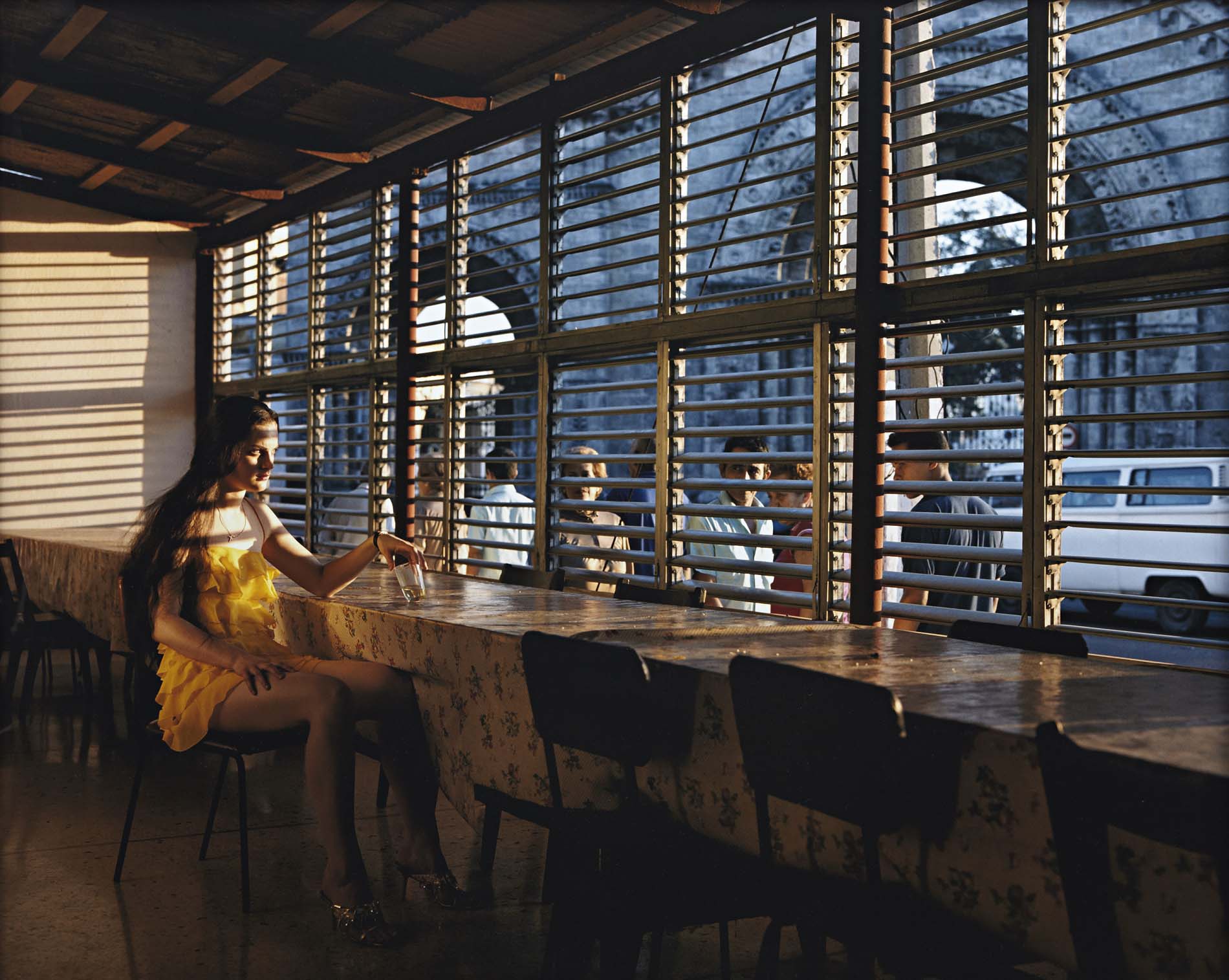
Gregory Crewdson's suburban settings of an elaborately detailed staged setup of American homes, interiors and neighbourhoods invoke haunting, cinematic photos of alienation and eerie isolation. I've always been interested in Crewdson's work in wanting the reconstruct the world in photographs. His ideas creates a sense of longing with his subjects within the photographs. A deep felt unhappiness that divides them from reality and fantasy adding to what he has created with his dream like world in this controlled environment. His work combines the documentary style of William Eggleston and Walker Evans with a dreamlike quality. Yet unlike those photographers, Crewdson is compelled by how the still image freezes time and sets limitations, once saying he is fascinated with how he can capture a cinematic moment and freeze it for all time. His quietly disturbing American settings, with their immaculately staged lighting and sombre, solitary figures, are often seen as working in conjunction to the works of Edward Hopper.
For my series of images, I wanted to present the emotions of the figure. It is left unintentionally unclear what the subject is experiencing. However this adds to the photographs, giving an underlining mysterious nature to the subjects.
Using Adobe Lightroom and photoshop, I added blue filters subtly into my images whilst retaining most of its colour. The blue gives connotations of a gloomy, lonely and supporting the emotions I intended to present. For many of them I too darkened the frame, reducing the light in the background.
MY RESPONSE 'TERRA FIRMA'
My Series reflects the social deterioration with dealing with mental health and the contemplation of seeking identity as well as the social struggles in a world vastly more interactive and yet ironically where it is increasingly more difficult to find closure. My inspiration comes from the collective works of Carrie Mae Weems, Philip Lorca Dicorcia and Gregory Crewdson, all of which inspired my final series called “Terra Firma.” These photographs were designed cinematically and reflect the works of Dicorcia, stylised like Crewdson’s with the subjects private lives being made exclusive to us like Carrie Mae Weems.
Overall with the outcome I was quite pleased with the results, Although I did not have the same resources as Crewdson did, I feel like it was a worthy achievement for me. The main tool used throughout the project was the manipulation of lighting especially with the last photograph which was particularly one of my favourites. Using the Adobe Light Room I was able to enhance the look of the lighting and tone in all of the images. A few issues I realised was that some of the images had randomised colour marks and that the subjects were looking at the lens in the last image, although I do believe it did not spoil the image itself but merely enhance the reality of it all.
Philip Lorca Dicorcia has been particularly known for his elaborative and aesthetically pleasing cinematic, documentary styled photographs. Dicorcia delves into the insignificant moments and what may be the most ordinary to others, triggering the psychology of emotions that makes us question what happens next. where does it go from here?
Dicorcia challenges the identity of individuals, much like Carrie Mae Weems who share similarities in work. Both paint a narrative mixture of truth and fiction which dramatises the set scene and creates an accurate representation of life today. I like his pieces because they've been referred to as documentary photography with the fictional world of cinema and advertising which has powerful meanings of reality and desire combined with fantasy. What I like most is all the subjects display accidental poses or unintentional expressionless faces which distorts them from the world around them adding to the appeal of a theatrical touch.
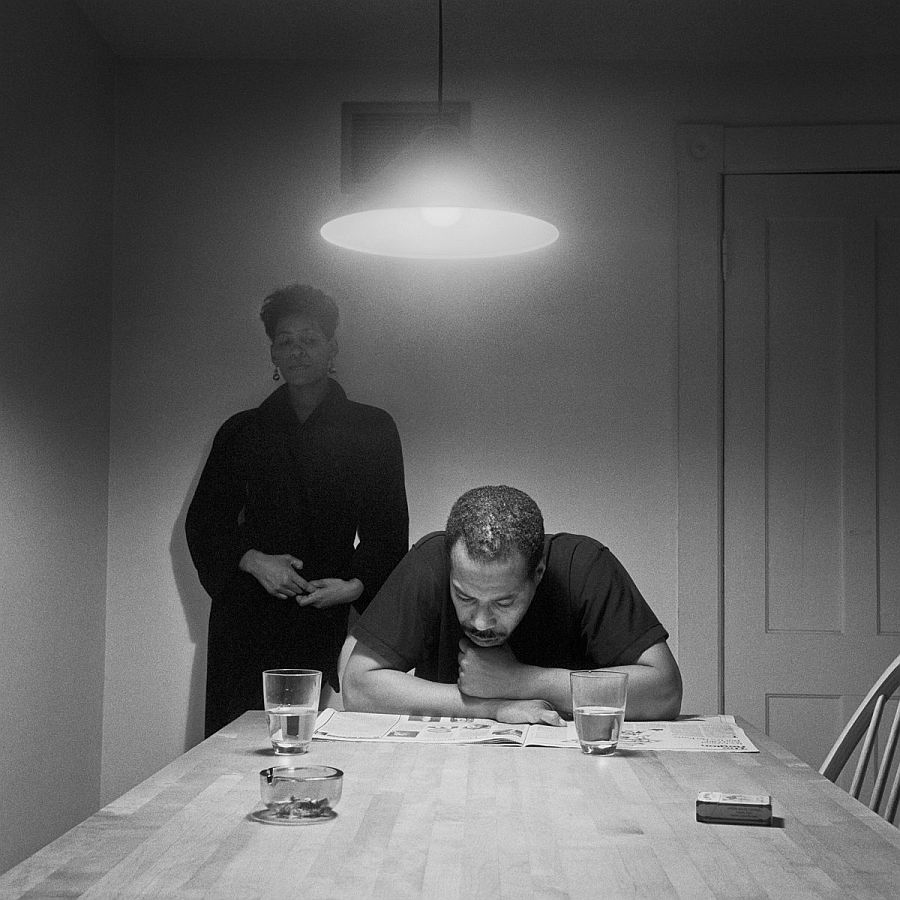
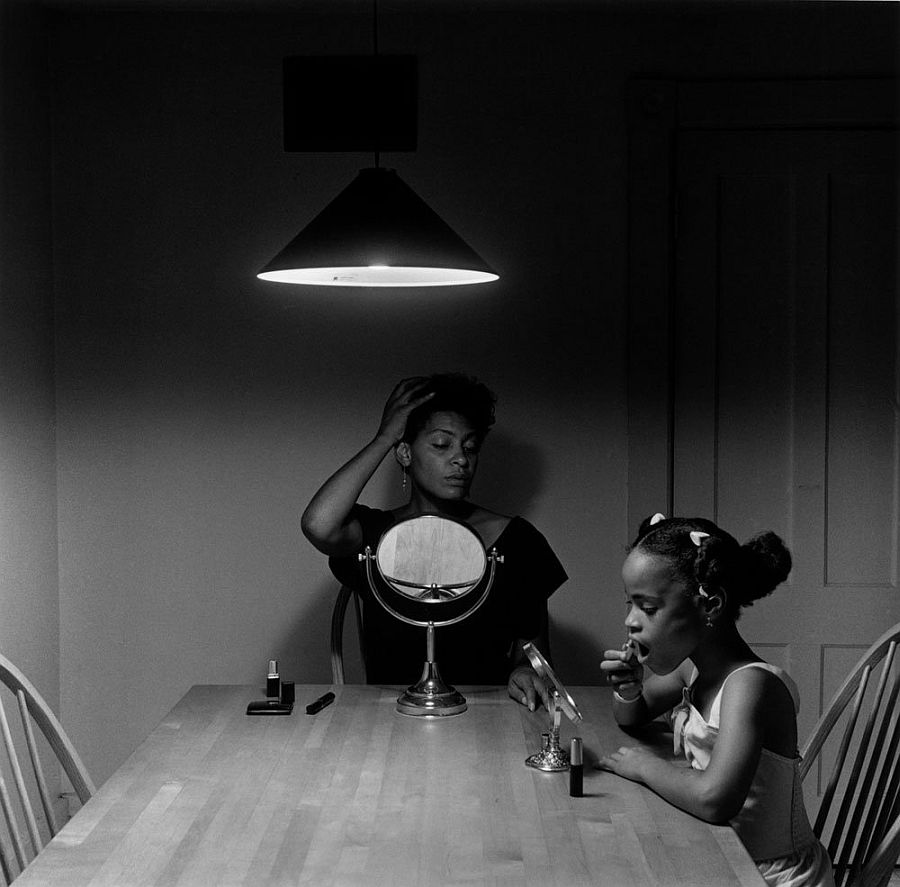
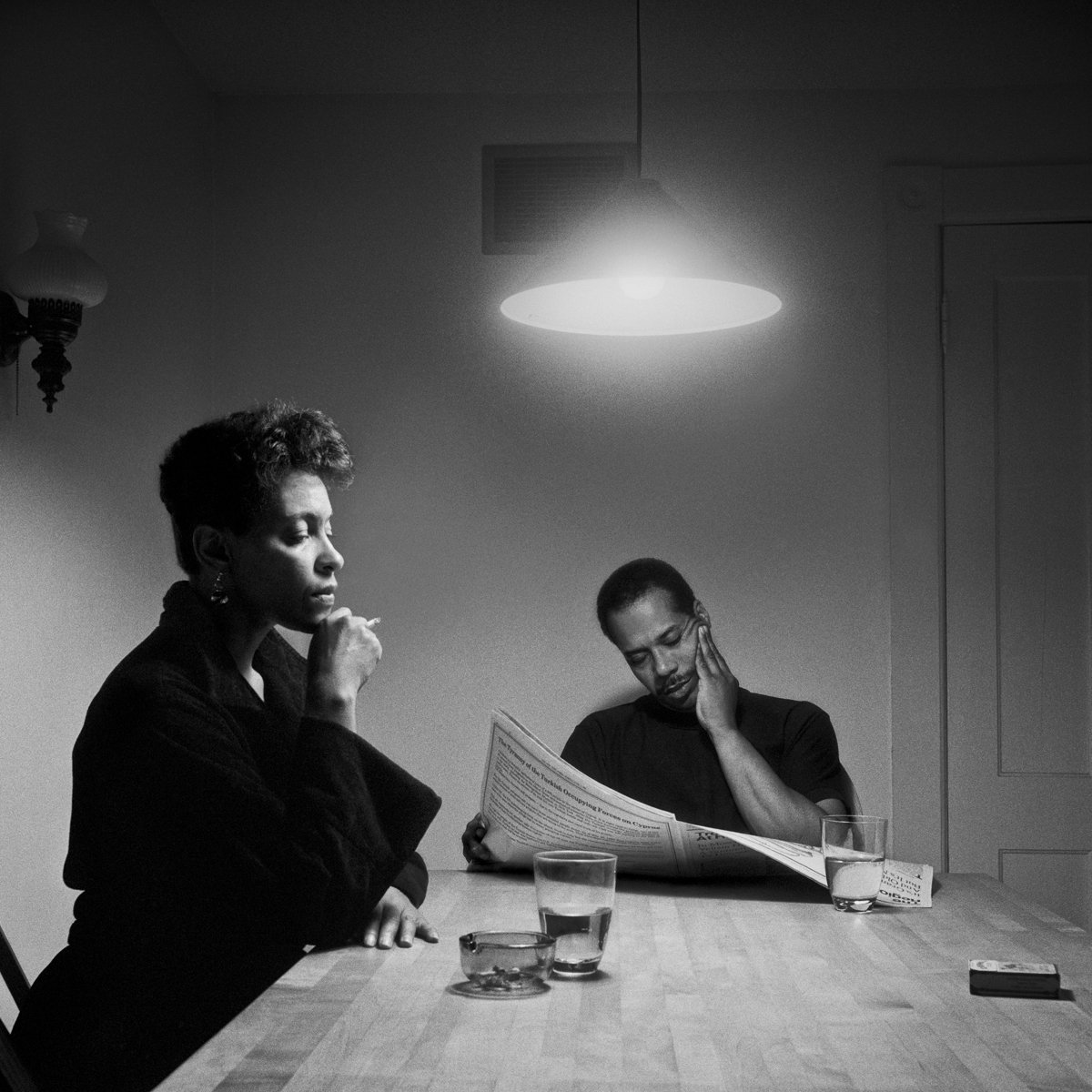
Carrie Mae Weems tells us the story of her life conveyed in the setting of her kitchen. This domain traditionally ruled by women reveals and important insight to the life and relationship she has with her family and her habitat. Weems expresses this art work as a depiction of the battle ground around the family and between sexes. Whats interesting to see is that Mae Weems openly reveals herself in the most plainest form possible.This is interesting to the viewers because it breaks the walls down to privacy and in essence creates vulnerability and solitude to the individual being viewed, yet somehow despite all these debilitating effect, It creates a mode of strength and confidence, a window to their souls if it were and the readiness to share a secret. This is all part of her collective theme, family, identity, sexism, class, power and cultural differences.
I love the way we are able to capture human life in their most natural state in an area exclusive to the rest of the world. What seems to be a common feature is the lack of communication and even the sense of isolation perhaps, a metaphor to a lack of common interest with the subjects or even a debilitating social relationship through the preoccupation of other self fulfillments.
Overal I'm happy with the success of my first experimental sound piece and its final outcome. Though my piece took a different path in comparison to how I originally intended it to be. I unexpectedly produced a piece that still had the elements of the Dulle Griet painting in it.
I found the whole project brought out a much more creative mindset within me. Making each individual sound out of items I had around the house was incredibly fun. The realisation that I could use simple materials such as tin foil to create a sound that, when the audience cannot see the material, they would instead interpret to be a crackling fire, was a satisfying experience.
To create the sound I used a variety of household materials such as; Tin foil, Paper and Bubble Wrap. I also manipulated the voices of my family; using my Sister's voice to create a screaming sound and my Mother to make the demonic roar. My dog's howls and barks were also particularly fitting with the atmosphere that I wanted to build in this soundscape. Additionally I used the wind throughout and my brothers Guitar, and Violin to create the pitchy music playing through the piece.
I did however forget to edit out a particular sound that I was not keen on - in future I will need to ensure that I constantly check back over the entire piece and make notes for changes that need to be made. The mistake here is that I was maybe improvising too much, and not planning enough or taking down any notes on the quality of the sounds I was using.
I do also need to become more confident with Adobe Audition, as this was the first time used it professionally and I found that it can be a little confusing when working with lots of different sound recordings in one project window. I will practice more by creating other projects in my own personal time and throughout the summer.
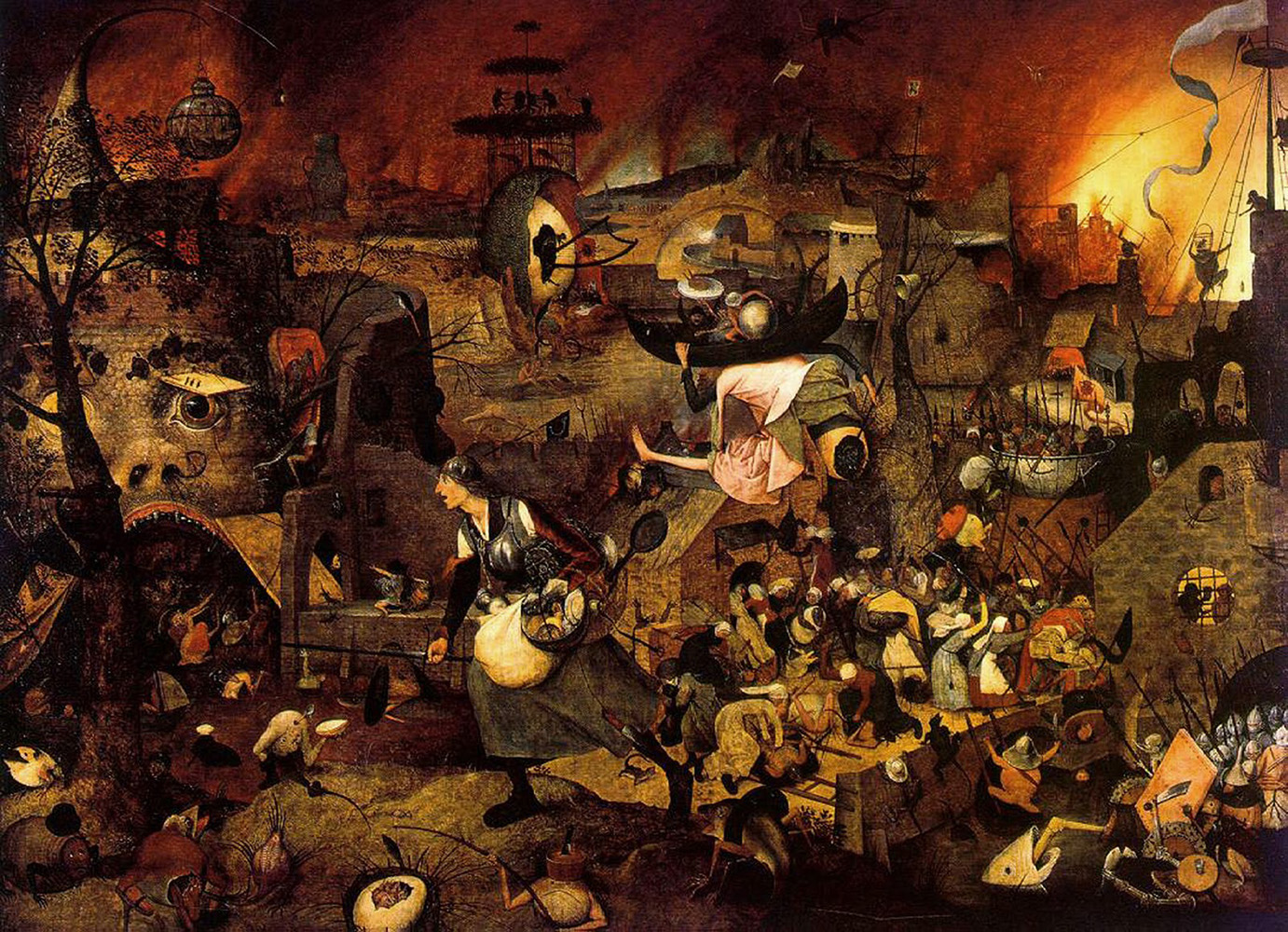
The saying goes in a book of proverbs, published in 1568. One woman makes a clamour, two women a lot of trouble, three an annual market, four a quarrel, five and army, and six the Devil himself has no weapon.
Pieter Bruegel the Elder's work has been inspired by local culture and towns folk beliefs. This painting was created around c. 1568 during the time of the renaissance era. At this time famine and poverty was ripe throughout Europe. Isolation became common amongst townsfolk and such beliefs began to play upon minds of the locals.
Griet which is the name of this piece is a denigrated name given to bad tempered, shrewish woman. It speaks a lot of how Bruegel's depiction of hell was clearly inspired by Boschian like creatures from the painter Hieronymus Bosch. Hence, Bruegel's intentions about this piece became clear. This painting depicts the mockery of ill tempered woman and their outbursts charging through hell, plundering the realm of its possessions and emphasising the fact that bad tempered women can run to hell and back, unscathed and unhindered due to their robust nature. What I found interesting was that the first time I saw this painting I believed to be another depiction of hell and the chaotic damned souls being punished by unnatural creatures. However upon learning more about it I became aware that this is a stampede of women plundering the caverns and sacking hell for all its treasures. This Painting can also relates to the saying "Hell hath no fury like a woman scorned." This piece creates and alternative meaning to the idea of Hell being the worst place on earth and into, a victim of greed and covertness.
For my Experimental sound project I'm going to try and create and eerie tune with various sounds of strong winds and raging fires down to loud screams and roars of onward plunderers moving deeper into hell, perhaps even creating sounds to accommodate the Boschian creatures, which hopefully will intensify the overall feel to this piece. My recording will begin over this week and I will be recording how I achieved my sounds.
The result was unexpected, yet however I am very pleased with the end result. My idea was to create a soundscape that had an western styled heart beating sound yet my end result came out a lot different and more to the style of dark ambient background. With this in mind here is my final version of my experimental sound project.
As part of our project with experimental sound we had to conduct research into the development of our own pieces. My research began by looking at major movie scores as well as from past and upcoming blockbusters. The intentions at first were to create a fast beat track that had elements of a plunder or raid. I wanted to explore this idea because it relates back to the Dulle Griet painting my experimental sound will be based off from. When searching for ideas I found the following tracks which included different parts of how I wanted the middle part of my piece to sound like.
After considering how I wanted the middle to sound like I wanted the beginning of my experimental sound to have an ambient dark background noise. So I decided that adding a violin or flute to give it a sort of eerie affect. The best example I could find of my idea was the Joker's theme in The Dark Knight by Hans Zimmer, below.
Following on from the Joker theme tune I began to search other composers who could produce a similar piece and so began looking at the works of Debussy, Johann Johannsson and others.
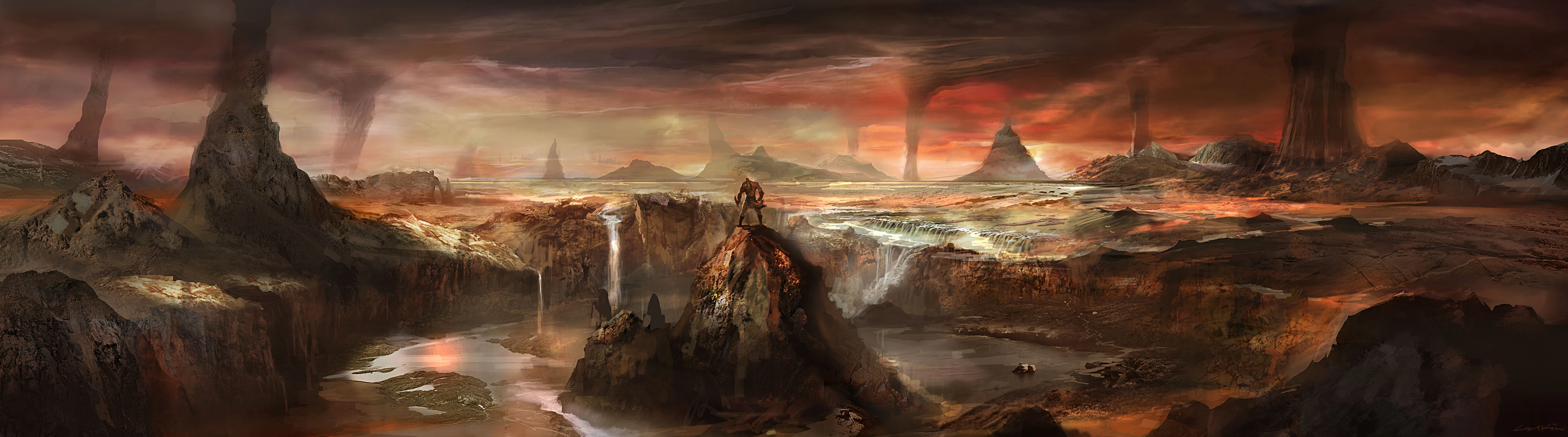
God Of War - Video Game/ Concept Art
As part of my visual research I wanted to search for other depictions of hell in order to gain a sense of what could be inspiring to my piece and so began looking at concept art and, in particular, the works from a popular game called 'God of War.'
God of war is an Action/Adventure based game on stories from Greek Mythology. Greek Mythology has been known to be very popular with its depictions of Heaven and Hell throughout the centuries and visions of God's portrayed in various paintings by famous painters.
I found this inspirational because some of the in game sounds sound similar to what I would like to achieve.
TREATMENT AND SYNOPSIS
Working Title: Times Changing
TIMES CHANGING
Synopsis
This multi screen film features a character who on one screen symbolises repression and manipulation, in an Orwellian artificial bureaucratic setting. On the other screen we see the character expressing themselves freely in a setting in which anything is possible, exposed to a place of freedom and creativity, symbolised by the use of different filming locations or ways to create different settings, such as the place the character first enters; an alleyway.
Treatment/Shot list
Screen 1: A middle aged male character wearing dark plain neutral attire is seen in a office, sat at a desk, staring outwards. A dead plant sits in the corner of the room. The sound of a clock ticking can be heard and the character’s hand can be seen, typing at a computer. Everything about the scene is dull and dystopian.. Lont takes from different angles of the man and his unimpressed expression could be used to see the bland expression throughout all aspects of the character, from facial expression to body language. During moments of this screen story will be cut to a plain white wall, where the paint is drying. Another way to show this is the idea of watching paint dry, which can be interpreted by the shot of the wall, alternatively by the same wall with a ‘Wet paint - Do not touch’ sign; symbolising the idea that reality being as dull as watching paint dry. The phrase ‘Do not touch’ shows authority and that reality features a dictated and controlled society in which pressure dictates individuals choices. There could also be shots of a clock as it ticks, showing a source, different separated shots of the clock could show time progressing faster than it actually is, along with continuing tick of the clock which is steady and unchanging, representing the unchanging and repetitive aspect of life in this reality. The shots of the character could also pan outwards to show a want for this kind of reality to fade away, making room for a reality of freedom and change as well as the idea of living in a reality like this is to fade out of history, not making any sort of change.
Screen 2: On a separate screen at different times but sometimes overlapping, another reality will be shown. This reality starts out dark and unknowing and would be a first person point of view shot, as if looking for a way out, for change, freedom and a new way to live. This secondary screen transgresses the first screens themes. The character stumbles upon an alleyway which as a stereotype is often a dangerous place. However, in this reality he has freedom and the second screen explores the alleyway, because they can be whatever the character wants them to be. Therefore as we journey down the alley with this character we find all kinds of fun and crazy things that challenge the stereotype of a typical alley, which then becomes their escape, their reality, their creativity and their freedom; their imagination. Things that will be able to be seen in the alleyway will include vibrantly coloured lights and additional characters which will be doing all kinds of crazy things, wearing whatever they want and doing things that we may consider normal and or fun, yet in a confined and suppressed reality of control these things are considered wrong, representing a transgression and showing the character to be rebelling. One of these acts could be something as simple as using silly string or party poppers to represent an aspect of celebrating life and freedom but also giving a childlike aspect that shows that the character is lashing, wanting to be free, also represented by the bright colours, with all of these aspects also challenging stereotypes. As the character continues to progress the setting could possibly change and we can represent the idea of transgression and the thought process of the character through the use of colour, time as well as the structure of the film. The film will end by reaching a conclusion, a point that the character reaches in which they have fulfilled their goal of transgressing, and challenging the society and reality that we see them in through the first screen. This can be shown through time seeming to go a lot faster, showing that things are changing, only for everything to stop and for the character seen in the first screen to stand up and walk out of the room as if finally deciding to do something about that way of life and that reality, in a way seeming like everything shown on the first screen was a dream or the thoughts, wants and desires of the character, also implied by how bizarre everything seemingly is in this alternate reality which through this can symbolise a society in which freedom is celebrated but also the thoughts of a person living within the first reality.
The ideas behind this film are inspired by both the world around us, as well as an idea, a way that society could be. Not only this but also the thoughts of someone who desires freedom and/or change.
Hera are some inspirational videos we've looked at that have inspired us:
How to recognize a dystopia - Alex Gendler
What makes something "Kafkaesque"? - Noah Tavlin
What "Orwellian" really means - Noah Tavlin
Mind Control corporate espionage, Directed by Vincenzo Natali.
Equilibrium, Directed by Kurt Wimmer, 2002.
This intense, unsettling film draws heavily from George Orwell's classic, 1984. Writer/director Kurt Wimmer substitutes "Big Brother" for "Father," whose voice and features are projected across Libria on enormous television screens, constantly reminding people of the dangers of the natural human state and the devastation it had led to in earlier, less sophisticated societies. Where Orwell has "thought police," Wimmer has "sense police." States in Orwell's world subdue their populations by the need to maintain their war efforts, while Libria's justifies the abuse of its people through the notion of sustaining peace. -Nell Minow, Common sense media.